2017年11月7日火曜日

平組 AADC

幅の広い紐を組みます。AADCです。AADDと比較するために、ほぼ同じ色の配置でやってみます。


4回目にひねるか、ひねらないか、でこんなに違った結果になるのですね。AADDと比べると、幅が広い分、厚みはそれほどありません。配色は次の通りです。8-7とあるのは、ループの数が左手8本、右手7本の意味です。

赤系4色 8-7 ④④①①①①②②  ④④③③③②②
紫系7色 8-7 ⑦①①②②③③③  ⑦⑥⑥⑤⑤④④
赤緑黄 8-7  ②①②①②①②①  ③③③③③③③

グレーピンク白  山道 8-7  ②①②①②①②③  ①③①③①③①
                                                   ①①①①①①①①  ①①①①①①①

上3本はすべて単色ループですが、4本目の白グレーピンクは、2色ループと単色ループの両方を使っています。 実は全く違ったものを想定していたのですが、結果はこうなりました。嬉しい誤算です。2色ループは、「閉」で上下の色が変わるので、私の頭で考えた通りには行かない点が、面白くもあり、憎らしいところです。「山道」という名前も素敵ですね。

We try a wide braid AADC today.  To compare the difference from AADD, I used almost the same color threads.


It is amazing.  We get a completely different pattern by changing the 4th movement from “D: cross” to “C: open”.  The finished braid is wider than AADD and therefore thinner.  The color arrangements are as follows: 

4 reddish colors 8-7   ④④①①①①②②  ④④③③③②②

7 purplish colors 8-7     ⑦①①②②③③③  ⑦⑥⑥⑤⑤④④

Red,Yellow,Green 8-7     ②①②①②①②①  ③③③③③③③

Grey,Pink,White, Mountain Path 8-7 ②①②①②①②③  ①③①③①③①
                                                               ①①①①①①①①  ①①①①①①①

The top 3 braids are made with single-color loops, and the forth with single- and bi-color loops.  In fact, I planed to make a completely different pattern, but got this.  It was a nice surprise!  For me, bi-color loops are difficult to foresee the results because they change colors each time loops are twisted, which is interesting and troublesome.  The pattern name, “Mountain Path” is beautiful.

8-7 means 8 loops in the left hand, 7 loops in the right hand. 

2017年11月1日水曜日

修多羅(しゅたら) Sutra

京都国立博物館の国宝展へ行ってきました。お目当ての法隆寺の四騎獅子狩文錦もじっくりと拝見でき、1度訪れたいと思っていた清涼寺の釈迦如来像も拝見できました。あちこち出かけなくても、立派な仏像や絵画が一堂に集められているのは嬉しいことです。組紐関係では、神照寺の宝相華唐草文透彫華籠はありましたが、予想通り、肝心の紐ははずしてあり、見ることはできませんでした。

教王護国寺(東寺)から七条綴織袈裟と横被が出展されていました。その横被に修多羅というものがついていました。よく似たものを見たことがあると思ったのは、聖徳太子1390年御聖諱法要で、正装したお坊様が肩から後ろに垂れ下げておられたものでした。


東寺のは、緑赤黄紺の4色の組紐です。横被は9世紀の唐から来たものだそうで、修多羅も当時のものなのか、確認するのを忘れました。

帰ってから、「修多羅」をインターネットで調べてみると、元のサンスクリット語は、スートラ sutraで、元々は糸、織物の経糸を意味したものが、経典を意味するようになったそうです。スートラを中国語に翻訳するときに、音訳したのが「修多羅」、意訳したのが「経」です。

糸を意味するスートラが、経典を意味するようになったのは、スートラが、経糸のごとく過去・現在・未来を貫く不変のものであり、それに対して様々な格言や規則、思想、理論などが緯糸として織り込まれ、織物全体が人間の偉大な知恵を形成するものだから、なのかなと、私なりに理解しました。

「お経」は経糸だったのだ!と初めて知りました。仏教に興味はあったのですが、急に自分の趣味である織物や糸、紐に近い話になって驚きました。そう言えば、前から思っていたのですが、英語のTEXTとTEXTILEはどこかで繋がっているのではないか。その答えが、この辺にあるような気がします。

ともかく、漢字の修多羅が経と一緒に日本に来て、経典以外に、僧侶の袈裟の装飾品を示すようになったのは、なぜでしょうか。恐らく、元の意味の「糸」を使ったものだからではないでしょうか。


国宝をたくさん見て興奮し、新しい言葉「修多羅」を覚えて、さらに興奮しました。


One day in October, I went to the Kyoto National Museum to see the National Treasure Exhibition.  Among others, there was a priest’s garment decoration called “sutra 修多羅”.  It is a complicated knotted kumihimo.  The photo is a priest with a sutra attending a big memorial service.


I looked up the word 修多羅 on internet and learned that 修多羅 is the transliteration of the Sanskrit word “sutra” into Chinese whereas more familiar word 経 is the free translation of the same word.  I also learned that “sutra” meant in ancient India a thread, string or warp. 


How did the word meaning thread come to mean sutra?  It is explained in many ways, most of which are very interesting and complicated.  As far as I understood, sutra (warp) is an eternalness piercing through past, present and future, while various aphorisms, rules, thoughts and logics are woven as a weft.  The whole textile is the accumulated wisdom of mankind.


So the sutra was a warp!  I have been interested in Buddhism, and I was amazed because the topic suddenly turned into something familiar to me, like thread, weaving, and string!  It reminds me that for some time I have been wondering that Text and Textile should be somehow related.  The answer might be hidden in this story of sutra.


Then why did sutra come to mean a garment decoration for a priest?  Perhaps it is made with a kumihimo, threads, the original meaning of sutra.


It was an extremely inspiring day in Kyoto.

2017年10月24日火曜日

源氏打ち Genjiuchi BBCC

「クテ打組紐技法入門」シリーズから源氏打ちBBCCを取り上げます。初期の配色設定は以下の通りです。
(ア)  ①②①②①② ②①②①②①
             左手       右手

左右対称です。これを非対称にすると、

(イ)   ①②①②①② ①②①②①②

がらりと変わります。紐は丸みを帯びていますが、ループ数が偶数なので、右手側面がやや広く、左手側面はそれよりは狭くなっています。巾着の紐などにちょうどいいですね。

真の一番上の茶と黄色の紐は、途中で(ア)から(イ)に変え、また(ア)に戻りました。ループの配置を変える時は、1度に変えるのではなく、組みながら順に変えていった方が、仕上がりに無理がなく滑らかになります。


3色でやってみました。
(ウ)   ①①①①①① ②③②③②③  

 
(エ)   ①①①①①① ③②③②③②


写真2番目の緑、ピンク、グレーの紐は、最初は(ウ)で②のグレーが右側面に来ました。(エ)にすると、③のピンクが右側面に来ました。


次は4色です。
(オ) ①②①②①② ③④③④③④


(カ) ①②①②①② ④③④③④③


左右の側面には左右同じ色(単色)の矢羽根ができ、上下の面には左右異なる色の矢羽根ができます。これを全て単色の矢羽根にできないかと考えたのが一番下です。

(キ) ①②①②①② ③①③①③①
    ④②④②④② ③④③④③④


① と④の2色ループを6本、単色ループ②と③をそれぞれ3本ずつ使っています。


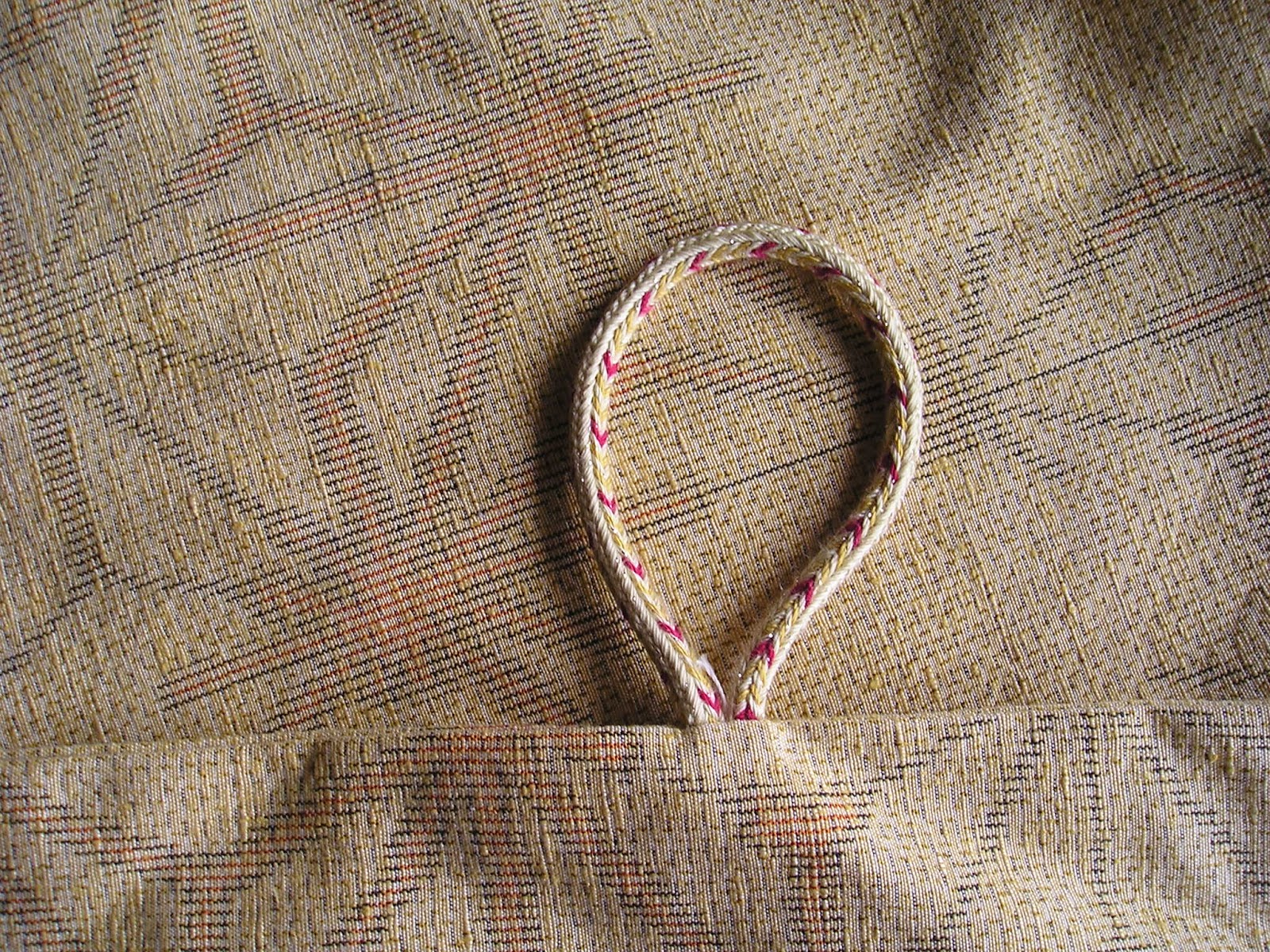
応用作品です。紬の着物地でスカーフを作りました。スカーフが滑ってこないように、源氏打ちの紐を肩の辺りに縫い付けました。
 (ク) ①①①②①①  ②①①①③①

いつもはコットンキングを使っていますが、この時は幡垂飾を組んだ残りのハマナカのアプリコを使いました。ベージュは金ラメ入りです。

We try Genjiuchi BBCC from the book “Introduction to Kute-uchi Kumihimo Technique”.  The initial color arrangements are as follows.

A)  ①②①②①② ②①②①②①
    Left       Right

Bilaterally symmetric.  We can change it slightly like this.
   
B)   ①②①②①② ①②①②①②

The pattern changes dramatically.  The braid is round, but since the number of the loops is even, right hand side is a little wider than the left hand side.  The braid is ideal for drawstring purses.

To make the top brown and yellow braid, first I did A) then B) and back to A) again.  When you change loop positions, I recommend that you change loop positions one by one as you braid, rather than you change all the loops at once.  That way, the finished braid looks better.


The second one in green, pink and grey started like this.
C)      ①①①①①① ②③②③②③   
D)      ①①①①①① ③②③②③②

The grey② came to the right hand side when I started C), and the pink③ came to the right hand side when I changed to D).

Then four colors.
E)    ①②①②①② ③④③④③④
F) ①②①②①② ④③④③④③

On both sides we have two single-color chevrons alternately, and on top and bottom we have chevrons with different colors on right and left.  I wanted to have 4 single-color chevrons and came up with the following:

G) ①②①②①② ③①③①③①
  ④②④②④② ③④③④③④

I used 6 bi-color (① and ④) loops, and 3 single-color loops in ② and ③ each.


Here is a scarf I made with kimono material.  I attached a BBCC braid at around the shoulder so that the scarf does not slip down.

H) ①①①②①①  ②①①①③①

Though I usually use Cotton King, this time I used Aprico from Hamanaka that I bought to make Bansuishoku in April.

2017年10月13日金曜日

正倉院の大幡  Ritual Banner in Shosoin


秋は展覧会の季節です。奈良では毎年、正倉院展が開かれます。昨年は組紐で飾られた大幡が出品されたので、勇んで出かけました。全長458cm幅90の大幡がガラスケースの中に横たわっていました。まさしく威風堂々でした。ケースの上からじっくり見せて頂きました。本当は、幡をひっくり返して、裏側も見たかったです。かなり痛んだ部分もあって、白糸で抑えてありました。本体の幡身が青や赤のアップリケで目を引くものですから、組紐の部分もきっと鮮やかな色だったに違いありません。撚りの強い糸を使った一間組でした。奈良国立博物館の清水健氏の「正倉院の荘厳具-大幡に寄せて-」という講演も拝聴しました。その時のお話が大変興味深かったので、紹介します。

幡とは、古代インドが起源で、中国、朝鮮半島を経て日本に伝来した、仏教荘厳に欠かせない仏具でした。日本への仏教の公式な伝来は552年とされていますが、この時百済の聖明王が日本に贈ったのは、日本書紀によると、「釈迦仏金銅像一体 幡蓋若干 経論若干巻」だったそうです。金剛像を見た欽明天皇(聖徳太子のおじいさん)は、大層心惹かれたそうです。金剛像とお経の巻物と、その他の仏具とは聞いていましたが、その仏具というのが幡蓋だったことを今回初めて知りました。想像ですが、欽明天皇は、光り輝く金剛像もさることながら、はためく色鮮やかな幡にも心躍る気持ちになられたのではないでしょうか。幡というのは、お祭りの時などもそうですが、風にはためいて、人の心を高揚させます。


写真は2011年に法隆寺で行われた聖徳太子1390年御聖諱法要で使われた現代の幡です。法隆寺にはもっとすごい金銅製の潅頂幡が伝わっており、これを復元したものを東京上野の法隆寺宝物館で見ることができます。

正倉院の大幡は、757年5月2日に東大寺で行われた聖武天皇一周忌斎会の時に用いられたそうです。この法要には1500人の僧侶が参列し、大変盛大なものだったそうです。大幡も少なくとも10本、それより小ぶりの道場幡は600本以上並んでいたそうです。大幡は今残っているのは4メートル余りですが、元は幡脚も入れると15メートルにもなったそうですから、それが10本以上並ぶと圧巻だったに違いありません。しかも、1周忌斎会は奈良の都だけではなく、地方26か国の国分寺国分尼寺でも行われたそうで、そのために丈六の仏像がまだできていない所は急いで完成させよとのお触れが前年の6月3日に出ています。そして12月20日には、潅頂幡1と道場幡29首のセットが既に26か国に送られました。聖武天皇が亡くなって1年の間に一周忌の準備は都と地方において着々と進められ、当日はそれはそれは見事に華やかな法要が営まれたのでした。


大幡を作る職人さんたちはきっと、気合を入れて頑張ったことでしょう。地方へ送る26本は12月までに、東大寺で使う10本以上は翌年6月2日までに仕上げなければなりません。錦や綾などの豪華な材料を集め、色を吟味して、手分けして作業が進められたことでしょう。

組紐は一間組です。幡頭の三角形の部分は山道柄ですが、山道は直線ではなく、緩やかなカーブを描いています。1992年発行の「日本の美術1 No.308 組紐」の解説で、当時の道明社長の山岡一晴氏は、「高台ではあのカーブはできません」と述べておられます。私がクテを使って組んだ一間組もよく似たカーブを描いています。


当時はどんな道具を使ってどんな工房でどんな職人がどんなことを思ってこれらの組紐を組んだのでしょうか。

It is autumn, a season of exhibitions.  In Nara, Shosoin Exhibition is held every year.  Last year I went there to see the ritual banner decorated with kumihimo.  A large banner, 458 cm in length and 90 cm in width, was laid down in a glass case.  It did have a full-blown dignity.  I could observe the banner through the glass to my heart’s content. I would have been happier if I could have turned the banner to see the backside of it as well.  Some parts were severely damaged and were protected with white threads.  The main body of the banner was appliqued with red and blue.  So the matching kumihimo must have been in vivid colors when it was made.  The braids were braided in ikkengumi (single-unit braiding) with strongly twisted threads.  I also attended a lecture by Mr. Ken Shimizu of Nara National Museum, which I found very interesting and I am going to tell you about it.

Banners originated in ancient India, and came to Japan through China and Korean Peninsula.  They were indispensable ritual ornamental articles for Buddhist services.  Officially, Buddhism came to Japan in 552 when Seong of Baekje in Korean peninsula sent “a gilt bronze statue of Buddha, some banners and some Buddhist sutras” to the emperor in Japan. Then Emperor Kinmei was deeply moved when he saw the golden statue.  Though I knew about the  statue, sutras and some ritual articles, it was my first time to learn that the “ritual articles” in fact mean banners!  I can imagine how much Emperor Kinmei was attracted not only to the shinning statue but also to the flapping colorful banners.  Banners usually, like in festivals in Japan, flap to the wind and uplift our feelings.


The photo shows a modern banner used during the 1390th death anniversary of Prince Shotoku in Horyuji in 2011.  In fact Horyuji has a much gorgeous gilt bronze banner, whose replica can be seen at the Horyuji Treasure Museum in Ueno, Tokyo.

According to Mr. Shimizu, the banner in Shosoin was used during the first death anniversary of Emperor Shomu on May 2, 757 in Todaiji.  This memorial service was attended by 1500 priests and was an outstanding big Buddhist event.  There were at least 10 banners like this, and over 600 dojobans which were smaller than this one.  Though the remain of this existent large banner is only a little over 4 meters long, the original banner was over 15 meters long including banner legs.  So we can imagine what a sight to see it was with 10 banners standing in a row. 

What is more, the service of the first death anniversary was held not only in the capital of Nara, but also in National Buddhist temples in 26 local counties.  In order to highlight the memorial service, the government at that time ordered the 26 counties on June 3rd in the previous year to build a 4.85-meter tall Buddhist statue if they had not built one yet.  On December 20th that year, a set of one large banner and 29 dojobans were sent to each National Temples.  The preparation for the memorial service was carried out surely and steadily both in the capital and in local counties.  The memorial service must have been a really spectacular event.

Craft people must have worked hard for the banners.  They had to finish 26 banners for the counties by December and over 10 by June 2 the following year.  They gathered expensive materials like brocades and twills, carefully selected colors and broke into teams to get on with the jobs. 

The braids are “Ikkengumi (single-unit braiding)”.  The top triangular part is decorated with mountain-path pattern kumihimo, but the path is slightly curved instead of straight.  In “Arts in Japan, No. 308 Kumihimo” published in 1992, Mr. Kazuharu Yamaoka, then President of Domyo Kumihimo Company, said “this curve cannot be made with Takadai.”  The photo below is a ikkengumi I braided with kute.  It shows similar curves.


I wonder what kind of people braided these banner braids using what kind of tools in what kind of places thinking about what?

2017年10月9日月曜日

二連角組その2 Double Kakugumi AADD Part 2

今日はまず、私のネタ本を紹介します。木下雅子著クテ打組紐技法研究会編纂発行の「クテ打組紐技法入門」およびその続編計3冊です。おそらく大きな図書館にあると思いますので、探してみて下さい。CDも付いています。表紙のカラー写真がとてもきれいです。分かりやすい文章と図解で丁寧に説明してあります。
さて、その中から二連角組を組んでみました。


緑と薄い黄色の単色ループ14本を使った2色組です

①①②②②②①    ①①②②②②①
         左手     右手  
 
これを変形したのがその下の2本です。
赤系   ④④①①①①② ④④③③③③②
               左手     右手 

紫系      ⑦①①②②③③  ⑦⑥⑥⑤⑤④④
                                     左手     右手


暈繝です。このまま帯締めにもできそうですね。ポシェットの紐などにも使えます。


次に、「クテ打組紐技法」からもう2つです。一番上は、緑とベージュの単色ループ14本を使った2色組です。緑が縁取りになっています。     
      ②①②①②①②  ①②①②①②①
                                    左手     右手

続いては、2色ループを使いますので、少し複雑です。矢羽が2列並びます。    
                    
①②①②①②①  ①①①①①①①
                     ②①②①②①②     ②②②②②②② 
         左手     右手

この組方の裏を見て3番目のパターンを考えました。2色ループを2種類14本使います。配色を変えていろいろ楽しめます。写真では、①緑、②肌色、③ベージュ、④茶を使いました。

                       ①②①②①②①  ②①②①②①②
                       ③④③④③④③  ④③④③④③④
                                        左手       右手


以上は、あくまで左手から操作を始めることを前提にしています。どうしても右から始めたい人は、配色図の鏡像を使ってください。
配色図は、色別に①②③のように数字で表しています。最初はカラーでのように表記していたのですが、色数が増えると判別しにくくなるのと、白黒の方が自由に配色を考えやすいと思って、今のようにしました。


Today I would like to introduce my material books.  It is “Introduction to Kute-uchi Kumihimo Technique” written by Masako Kinoshita and published by Kute-uchi Kumihimo Technique Research Group.  It is a three-volume series with beautiful color covers and a CD.  Perhaps you can find it in major libraries in every prefecture in Japan.  It is in Japanese.  The books explain in plain Japanese and clear graphics.


From the books, I tried Double Kakugumi, which uses 14 single-color loops in two colors (green and yellow).  
      ①①②②②②①     ①①②②②②①
         Left       Right  

 
I modified this and made two more braids.

Reddish one ④④①①①①②  ④④③③③③②
       Left        Right 


Purplish one ⑦①①②②③③  ⑦⑥⑥⑤⑤④④
       Left        Right  


These are Ungen.  How about making a string for a pochette?


Two more braids from the books.  The top one is made with 14 single-color loops in green and beige.  The green color edges the braid.
     ①②①②①②①  ②①②①②①②
        Left       Right 

  
The second one is made with 14 bi-color loops, which is more complicated. It makes two rows of chevrons. 

     ①②①②①②①  ①①①①①①①
     ②①②①②①②     ②②②②②②② 
                Left        Right  

When I saw the back side of the second one, I got an idea for the third one.  It is made with 14 bi-color loops in four colors.  You can enjoy various color combinations.  The one in the photo is made with ①green, ②flesh color, ③beige, and ④brown.

   ①②①②①②①   ②①②①②①②
   ③④③④③④③   ④③④③④③④
    Left           Right  


All the instructions are based on the assumption that you start with your left hand.  If you want to start with the right hand, please use the mirror image of the charts. I use ①②③ for different colors.  I initially used color charts like , but I have changed it because colors get confusing when I have more than 3 colors.  Besides, black-and-white charts, I thought, will allow you to make your own color combinations more freely.


2017年9月6日水曜日

二連角組 Double Kakugumi or AADD


外回し開、外回し開、中通し閉、中通し閉 (すなわちAADD)を繰り返すと、角組を横に2つ並べたような厚みのある紐ができます。二連角組、あるいは御岳組と呼ばれているそうです。私の好きな組み方です。厚みのあるベルトにしたりします。

模様の出方が面白いので、いろいろと試したくなる組み方でもあります。写真はすべて単色ループの組み合わせですが、2色ループはもっと楽しいです。
 
上の2本は、ほぼ右手と左手を変えただけです。私はいつも左手のループから操作すると決めているので、初期設定をこのように変えて、違うパターンを出していますが、同じ初期設定でも右手から始めると、この2種類のパターンができます。多色ループで暈繝(グラデーション)にしたい時は、初期設定の順番が大事です。下の2本は14本で組んでいます。番号で表すと下のようになります。


②●③●④●⑤  ●①●●●●●

ところで、「暈繝」という言葉も、「正倉院の組紐」という本で初めて知りました。なんと天平の香りのする言葉ではありませんか。

念のため、ビデオもご参照ください。


訂正します。

写真中の配色図が誤っているとのご指摘を受けました。
失礼いたしました。正しい配色図をお知らせします。
  ●●●●●●  あるいは、
②⑥③⑥④⑥⑤  ⑥①⑥⑥⑥⑥⑥


When you repeat:

Out & open, Out & open, In & cross, and In & cross,
in other words AADD,


you can get a thick braid like two-connected-Kakugumi.  It is called "Niren Kakugumi (double-Kakugumi) or Ontake-gumi.  It is one of my favorites and I make belts with this braiding technique.  I like how each color appears and makes patterns.  All the braids in the photo are braided with single-color loops.  If you have bi-color loops, you can enjoy even more.


The top two braids are done with almost the same initial color arrangement only in opposite hands.  Because I make it a rule to always start with left hand loops, the initial color arrangements are different, but if you start with right hand and left hand with the same color arrangement, you can get two different patterns.  When you want to make a Ungen (gradation) braid with many different colors, you have to be careful about the color order.  Below I show a case of 14 loops.


②●③●④●⑤  ●①●●●●●

I learned the word “Ungen” for the first time when I read the book called “Kumihimo in Shosoin”.  What a graceful word!  That brings me the 8th century atmosphere.  Please watch the video to make sure you know how to do AADD. 


Correction:
One of the readers contacted me saying that the color arrangements are not correct.  It was my mistake.  Hire is the correct one.
  ●●●●●●  or
②⑥③⑥④⑥⑤  ⑥①⑥⑥⑥⑥⑥

2017年9月2日土曜日

バッグ用持ち手真田紐 Sanadahimo for bag handles


プレゼント用のバッグを作りました。本体はヤフオクで買った2種類のワイン色の帯地です。かっちりとできあがりました。持ち手はコットンキングで組んだ真田紐です。経糸42本で組んだのですが、もう少し幅が欲しかったです。長さも85%に縮みました。データを蓄積して、思う通りの幅と長さに仕上げられるようになりたいと思います。

真田紐の裏に、底に使った帯地(母のバッグの残り)を当てています。これは持ち手の幅を出したかったのと、手に持った時に絹の帯地の方が手触りが良いだろうと思ったからです。帯地はバッグにとても良い素材だと思います。時々ヤフオクを見てクリックしています。


A bag for my friend as a present.  The body is made with 2 different wine-colour obi-sashes I got through Yahoo Auction.  I am satisfied with the structured body.  The handles are Sanadahimo I braided with 42 Cotton King warps, which turned out to be narrower than I had expected.  The length also shrunk by 15%.  I am going to accumulate the data so that I can make Sanadahimo as wide and long as I plan. 

On the back of the Sanadahimo handles I attached the sash material I used for the bottom part (left-over from my mother’s bag) .  That is because I wanted to widen the handles and also I thought the silk material would make the handles feel softer.   Obi-sash for kimono is an excellent material for bags.  I sometimes visit Yahoo Auction and click.