ラベル 平組 flat braid の投稿を表示しています。 すべての投稿を表示

2022年10月28日金曜日

ブラウスに平織三間組 Sangengumi for a drawstring blouse


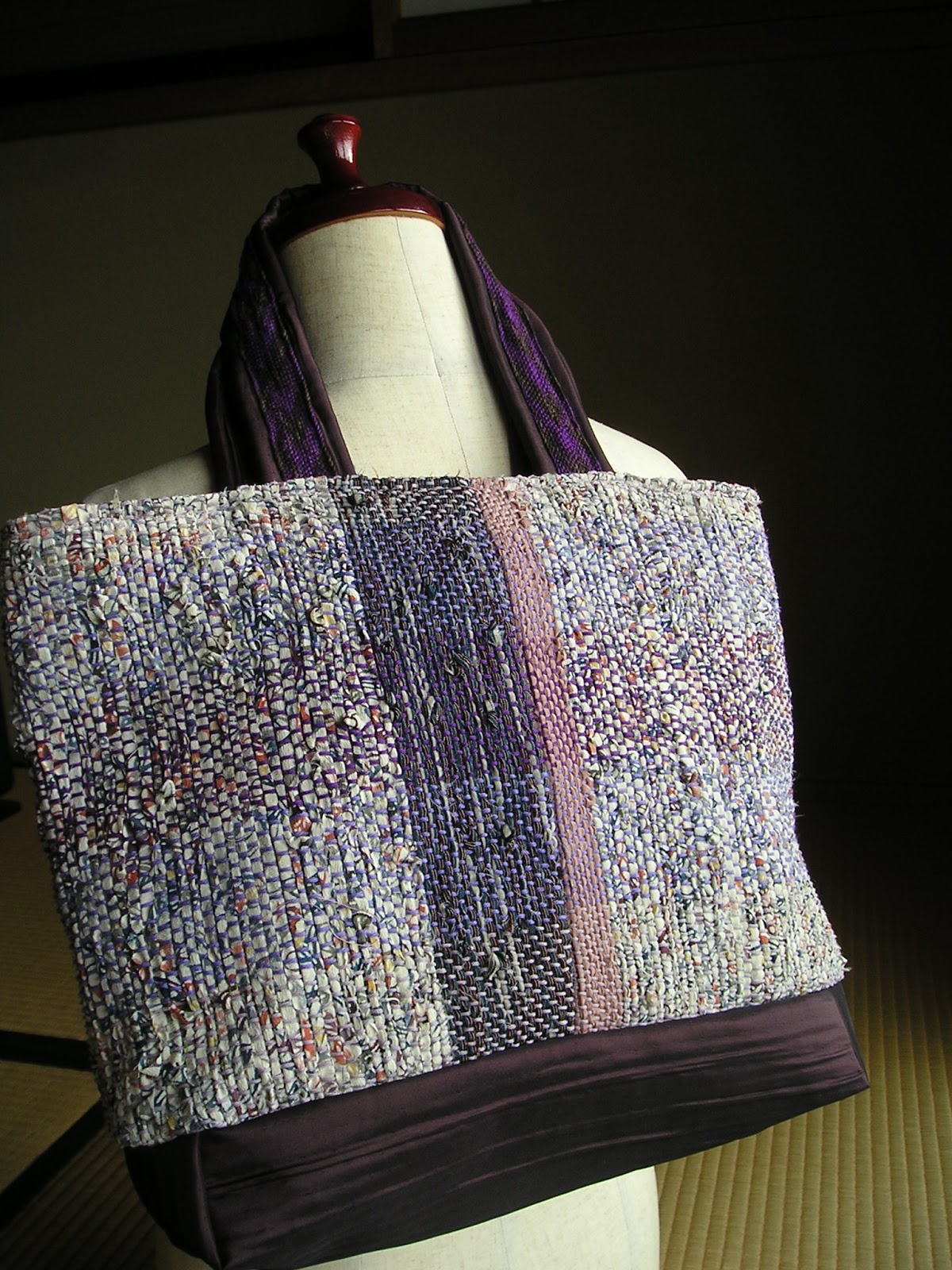
ブラウスを作りました。組紐を強調したデザインです。この型紙は30年以上も前に雑誌で見ていつか作ろうと思って取ってあったのですが、なかなかよい紐が見つかりませんでした。今なら自分で好きな紐が作れるのだと思いつき、作ってみました。生地は地味なオリーブグリーンで、組紐に使ったのは明るい黄緑です。糸はハマナカのアプリコで、ベージュと黄色にはラメが入っていて華やかです。


13本の平織三間組。初期配置は次の通りです。

〇〇〇〇〇〇 ◎◎◎◎●●

110cm必要なので、半分組み、真ん中で写真のように輪でつないでいます。アプリコは細くて、組むのに時間がかかるので、中央の40cm程は組んでいません。

思った通りの幅と厚みの紐ができ上がりました。30年前には自分でこんなに素敵な紐が作れるなんて思いもしませんでした。


I made a blouse that features a kumihimo.  I found the pattern of this blouse more than 30 years ago in a magazine and kept it for so long.  I had been trying to find a nice string for this blouse but I could not.  Now that I can braid, I can make whatever braid I want!  The material is rather quiet olive green, and I used bright yellow green for the string.  The yarn is Hamanaka’s Aprico.  The beige and yellow yarns are lame yarns, giving the finished braid some gaiety.

The braid is Hiraori Sangengumi with 13 kutes.

〇〇〇〇〇〇 ◎◎◎◎●●

The braid is 110cm long.  I first braided a half of the length, then connected the next half as the photo shows.  Aprico is thin and fine and takes long time to braid, so I did not braid the middle 40cm.

The finished braid’s width and thickness is exactly what I wanted.  I never dreamed 30 years ago that I would be able to make such a beautiful braid with my own hands.

2022年2月21日月曜日

斜格子一間組でバッグ持ち手  Oblique Lattice Single-unit braiding


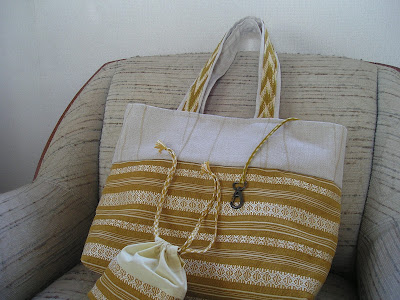
久しぶりのブログ更新です。プレゼント用に、ヤフオクでゲットした夏の博多帯(黄色)とカーテン地でバッグを作りました。同じ帯地を使って以前も作りましたが、今回は組み合わせたカーテン地との配色がさわやかな感じに仕上がりました。持ち手は以前のは真田紐でしたが、今回はクテ打ちで斜格子一間組です。鍵をぶら下げる紐は角組(CC)、残った帯地で作った巾着の紐はハマナカのアプリコで重打(CD)です。アプリコはコットンキングより細く、繊細に仕上がります。ベージュはラメ入りで豪華になりました。


Long time no see.  I made a bag using a yellow Hakataori kimono-sash for summer which I got through Yahoo Auction and curtain material.  I made another bag with the same Hakataori sash before.  This time, I matched it with  different curtain material, which gave the bag brighter impression.  The handles are Kute-uchi oblique lattice single-unit braiding, though the last time it was Sanada-gumi.  The key-holder is Kakugumi (CC) and the braids for the drawstring bag is Shigeuchi (CD) with Hamanaka’s Aprico.  Aprico is finer than Cotton King and the finished braids are more delicate.  The beige thread is spun with gold lame giving the whole braid a gorgeous look. 


2020年9月27日日曜日

平組二間組を偶数のクテで組む  Flat braid Nikengumi with even-numbered kute


前回紹介した青柳淑枝さんの「アンデスの組紐を訪ねて」の43ページに24本平組紐の組み方が載っていたので、組んでみました。24本の糸をまとめて、クリップでボードに固定して組みます。反対の端は固定しません。フリーエンドです。これは大変でした。いつもクテで糸を引っ張って操作しているので、フリーエンドには慣れていません。引き締め方が足りないのか、出来上がりは不揃いな組目になってしまいました。

今度は慣れたクテでやってみました。本と同じく24本の糸、すなわち12本のクテを使いました。左端のクテを取り、左から2越で右に進むと、最後にクテが1本残ります。最後のクテ1本を越えて一回捻って右端に置きます。

これにはいいことがあります。今までは二越の時は2の倍数+1本、すなわち奇数のクテでしていましたが、これだと、中心の片側で三越になって目立ってしまいます。でも偶数のクテで組むと、中心の片側は一越、反対側は二越になって、あまり目立ちません。

青柳さんの本の43ページでは、青柳さんの先生は中心が規則正しくきれいになるように、左の端は一越から始めておられます。なるほど、こういうちょっとしたことが仕上がりを左右するのだなと思いました。

写真は上から、24本フリーエンド、クテ12本、クテ13本です。

On the page 43 of “Exploring the Braids of the Andes” by Ms. Yoshie Aoyagi, which I introduced in my last post, there are instructions on how to braid a flat braid with free-end.  I tried this braid.  You tie 24 threads and fix the knot with a clip to a board. The other ends are loose, which was hard for me.  I am used to pulling kute tight.  Perhaps my tightening was not good enough, the finished braid has irregular stitches.

Then I tried braiding with kute.  Like in the book, I prepared 24 threads, eg. 12 kute.  You take the left-end kute (operating kute) and it goes over 2 kute and under 2 kute.  In the end you have one kute left on the right hand.  The operating kute goes over that last kute.  Then you turn the operating kute once and place it to the right-end.

I found a good point about this method.  Till now, I always used odd-numbered kute for Nikoshi flat braid. Nikoshi means over 2 threads.  The braid has a stitch over 3 threads on one side of the center, which stands out.  However, with even-numbered kute, you have a stitch over 1 thread on one side of the center and a one over 2 threads on the other side, which is less outstanding than a stitch over 3 threads.

On the page 43 in Ms. Aoyagi’s book, her teacher starts from left by going over one thread and then over 2 so that you have nice and regular stitches in the center.  I was impressed to learn that with such a small care, you can have much better results.

The photo above shows from the top to the bottom 24 threads free-end, 12 kute and 13 kute.


2020年2月9日日曜日

紫斜格子一間組 Purple Oblique Lattice Single-unit braiding


裂き織布と博多帯でバッグを作りました。持ち手は、博多帯地に一間組の紐を上から縫い付けました。今回は60cmの持ち手にしたかったので、糸は95cm用意しました。1本はそのままの長さで組みました。95cmだと、1回組む毎にクテを休め台に置いて、組めた部分を引き締めに行かなければなりません。これはかなりの運動量です。

それで2本目は中央から組み始めました。これならクテを持ったまましっかりと引き締めることができます。組目も規則正しくきれいです。問題は、中央から反対側を組む時です。組目をよく見て、クテを正しく付けなければなりません。今回はクテが15本でしたので、何とかうまくできました。


組み上がった部分は、初めの部分はV字型だったのが、ひっくり返したので、逆V字型になっています。そのため、初めは左から組みましたが、ひっくり返した後は右から組みます。実は、これに気づくのにしばらく時間がかかりました。

私の結論は、「長いものは半分に分けて組め」です。

半分に分けて組むと、クテを手放さなくて済むので、作業も 速く、快適です。快適に組んだ紐は組目もそろい、1模様の長さもほぼ同じです。きれいに組めると楽しくなって、さらに作業が進みます。

裂き織地も博多帯も地味な藤色ですが、組紐をつけて派手になりました。気に入っています。


I made a bag with a piece of torn-yarn woven fabric and Hakataori material.  For the handles, I stitched single unit braiding kumihimo down to Hakataori material.  I needed 60cm long handles, so I prepared 95cm threads.  


I started the first braid from one end.  It is so long that after each time I braid, I had to step forward to tighten the braided part leaving kute on the stands.  It is quite an exercise.  

The second handle, I started from the middle.  This way, I can tighten firmly holding kute all the time.  The braided part looks nice and regular.  The only problem is when you finish the half, you turn around the braid and attach kute.  You have to look carefully at the threads and attach kute in right order.  Luckily this time I only have 15 kute, and I could manage.

The first half end looks like a V letter, and when I turned around the braid, it is naturally in a reversed V letter shape.  That means now I have to braid from right to left whereas I braided from left to right in the first half.  In fact it took me a while to realize this.

My conclusion is, “You should braid a long braid from the middle”.

By starting in the middle, you do not need to leave the kute and can braid fast and comfortably.  Comfortably worked braids have regular stiches and each pattern has almost same length.  When your braid look nice, you feel happy and you work even faster.

Both the torn-yarn woven fabric and the Hakataobi material are grave mauve color.  But with the braids, the bag became lively.  It is going to be my favorite bag.

2018年12月17日月曜日

紫茶斜格子一間組 Purple and Brown Oblique Lattice Single-unit braiding


裂き織のバッグの持ち手を組みました。一間組です。これまでは、組目がはっきり見えるように、反対色などのコントラストの強い色を合わせて組んできましたが、今回は以前に織った裂き織布に合わせて、紫と茶の濃淡計415ループで組みました。こういう配色もいいなと思いました。使用糸はコットンキングです。


長さは55cmは欲しいので、90cmの糸を用意し、長さの中心から組み始めて端まで組み、中心に戻って反対側を組みました。写真でも分かると思いますが、糸が長い時ほど、締める力が弱いので1パターンの長さが長く、糸が短くなってくるとしっかり占めることができるので、1パターンの長さが短くなっています。パターンの長さは最大約1cmの差ができてしまいました。糸の長さに関わらず同じ強さで締めることができるようにならなければ。
 

長い紐を組むもう一つの方法として以前に紹介した、 Ingrid Crickmore のキャタピラーのやり方があります。今回もどちらにしようかと迷ったのですが、幡垂飾でやり慣れた方法を選びました。

でき上がりは、2.6cm55cmになりました。バッグも仕上がりました。底の部分にはカーテン生地の端切れを使っています。


Braided a pair of bag handles in purple and brown, using a technique of Single-unit braiding (ikken-gumi).  I have been using contrasting colors, like opposite colors, so that I can clearly see the braiding.  This time, in order to match the torn-yarn woven fabric that I made some time ago, I chose 4 colors, dark and light purple and brown, 15 loops.  This similar color combination is also nice, I thought. The material is Cotton King.

I needed the length of over 55cm.  So I prepared 90cm long threads and started from the center of the length, braided till the end, and started from the center again to the other end.  As you may be able to see from the photo, the length of the pattern varies.  When you have long threads, your tightening power is weakened, making the pattern length longer.  With shorter threads you can tighten firmly and get shorter patterns.  The difference between the longest and the shortest was about 1cm.  I must train myself to be able to tighten with constant power regardless of the thread length.

Another way to braid longer braids is, as I discussed showing Ingrid Crickmore’s method, Catapilar.  After wondering which is easier, I opted for the center-start which I got used to with Bansuishoku.

The finished braids are 2.6cmx55cm.  I also finished the bag.  The bottom part is a curtain remnant.

2018年6月1日金曜日

平組の一間組、二間組、三間組比較 Comparison of Ikkengumi, Nikengumi and Sankengumi

前の前の記事で、「越すループ数が多いほど、紐の幅は狭くなり、厚みが増します」と書きましたが、やはり実際に見て頂いた方がいいと思い、3つのサンプルを作りました。いずれも単色ループ3色で13ループを使用しています。初期の配色は次の通りです。

           ●●●〇〇〇  ◎◎◎◎◎◎◎


上から、一間組、二間組、三間組です。幅はそれぞれ27mm、22mm、18mmとなりました。残念ながら、厚みを測る道具を持っていないので、正確には測れませんが、ほぼ1.5mm、2mm、3mmです。下に行くほど、模様が圧縮されています。作業としては、越えるループ数が多いほど、速く組めます。

それと、前の記事で、「幅中央に、クテ打ちで平組をしたときに出る縦の筋」と書きましたが、それは、一番上の一間組で最も顕著に見られます。これは、ループ数が奇数なので、左から右へと組んで行ったときに、最後に操作ループを半回転しますが、そのループの片方の要素(糸)だけが、2要素を越えることからできます。ですから、この組紐は正確には、左右対称ではありません。

同様に、二間組、三間組でも非対称性が起こりますが、写真では判りづらくなっています。実物も見えにくいです。それはおそらく、一間組では、半回転した操作ループの1要素が2要素(2倍)を越えるのに対し、二間組では3要素(1.5倍)、三間組では4要素(1.3倍)を越えるので、次第に目立たなくなるからだと思われます。

I wrote in the previous article that the more loops the operating loop goes over and under, the narrower and thicker the braid becomes.  I made three samples to show it.  I used, for all the three braids, 13 single-color loops in 3 colors and the initial color arrangement is as follow:
   ●●●〇〇〇  ◎◎◎◎◎◎◎

From the top to the bottom, they are Ikkengumi, Nikengumi and Sangengumi.  The width are 27mm, and 22mm, and 18mm respectively.  Unfortunately I do not possess a tool to measure the thickness.  The thickness of the three braids are very approximately 1.5mm, 2mm, 3mm.  The patterns get compressed as the operating loop goes over and under more loops.  As for manipulation, the more loops you go over and under, the quicker you can braid.

In the earlier article, I also wrote, “a vertical line which is typically seen in Kuteuchi braids”.  That line can be seen the most clearly in the top braid, Ikkengumi.  This line is produced when you half-turn the operating loop after going from left to right over and under the loops.  When you half-turn the operating loop, one of the two elements (threads) of the loop goes over 2 elements.  Therefore, exactly speaking, the braid is not bilaterally symmetric.

Likewise, asymmetric nature happens with Nikengumi and Sankengumi, but in the photo we cannot see it clearly. Even in the real ones in my hand, the lines are less conspicuous than in the Ikkengumi.  I thought about the reason and came to the following idea.  When you half-turn the operating loop, with Ikkengumi, one element of the operating loop goes over 2 elements (200% of usual), while with Nikengumi it goes over 3 elements (150%) and with Sankengumi 4 elements(133%).  This decrease of % causes less conspicuity.

2018年5月16日水曜日

平組または一間組 Hiragumi or Ikkengumi


一間組は、操作ループが他のループを1本ずつ上下に越して組む方法ですが、これを2ループずつ越すと二間組になり、3ループずつ越すと三間組になります。越すループ数が多いほど、紐の幅は狭くなり、厚みが増します。だから、必要な厚みと幅に合わせて越すループ数を変えることで、希望通りの紐ができあがります。初期設定の配色の仕方で、さまざまなパターンを楽しむことができます。

3パターンとも単色ループ11本で、初期設定は次の通りです。
   〇〇〇◎◎◎◍◍◍◍◍

組み方は、ビデオをご覧ください。


写真の上から2番目の紐では、白と黄色の糸は、両端に留まり、中央まで移動していません。また、緑は中央に留まったままです。このやり方を次のビデオでご覧下さい。


写真の一番下の紐は、上の2つの方法を交互に繰り返しました。このように糸の移動を上手く制御することで、パターンの可能性がさらに広がります。


Ikkengumi means that an operating loop goes over and under other loops one by one.  When the operating loop goes over 2 loops and under 2 loops, it is called Nikengumi.  If it is over 3 and 3, it is Sankengumi.*  The more loops the operating loop goes over and under, the narrower and thicker the braid becomes.  That means, by changing the number of loops to go over and under, we can make a braid of exact width and thickness we want.  By changing the color arrangements, we can enjoy various patterns.
    
       * 1=ichi,  2=ni,  3=san  

I used 11 single color loops and the initial color arrangement is as follow:
   〇〇〇◎◎◎◍◍◍◍◍

Please see the video to know more about how to braid Ikkengumi. 


In the second top braid in the photo, the white and yellow threads stay on both sides while the green ones remain in the center.  I will show you how to do this in the next video.


The bottom braid in the photo is made by alternating the two patterns. By controlling the movements of thread using this technique, we can have even more variations of patterns.